



Picture this, a game where you go out and beat things into oblivion, then you return to your base, make some things, and put them up for sale while you decorate and play house. That is exactly the elevator pitch for Cloudheim. It’s a game that recently went into early access, and while it still has quite a ways to go, it has proven to be a formula that works, both in a solo setting and a cooperative one. There are a few grievances in its current state, but you can easily look past them when you engage with the grander picture of what Cloudheim has to offer.
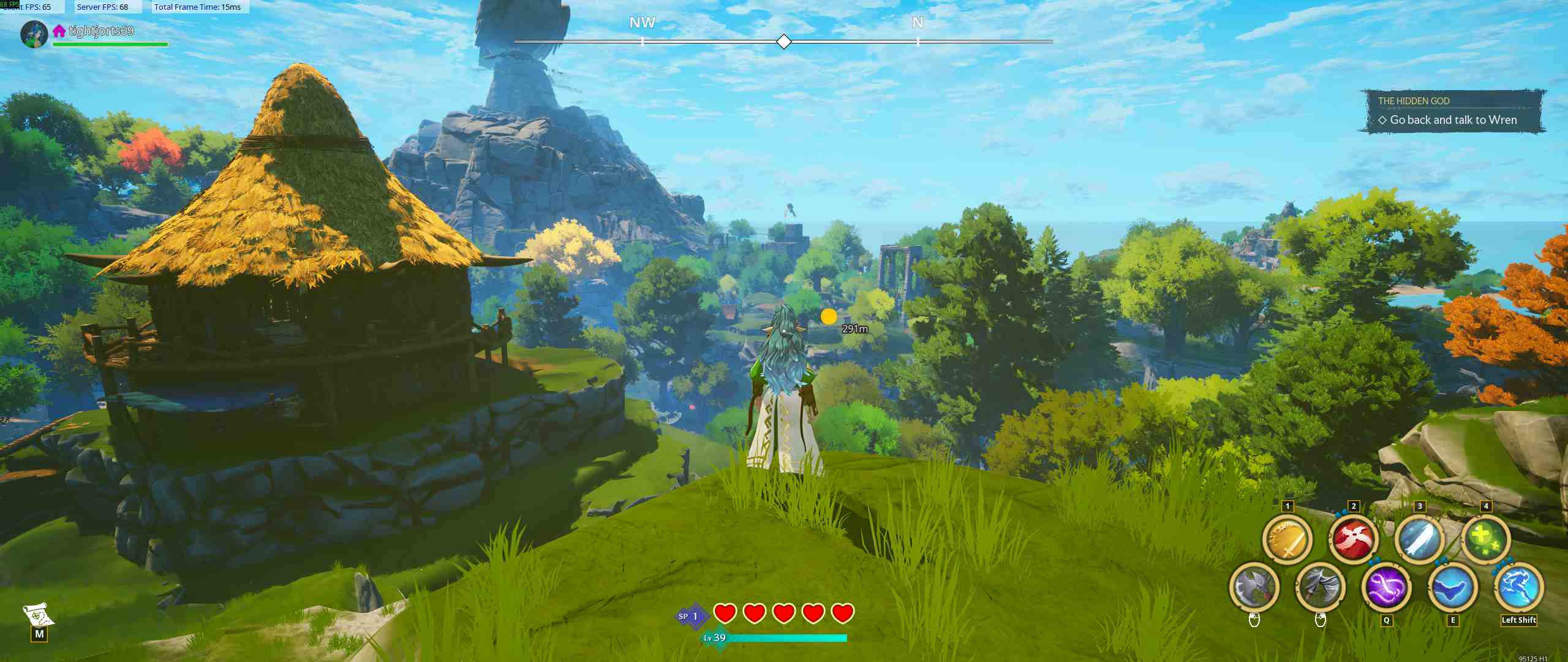
Cloudheim’s story is nothing great so far, but also nothing terrible. The world is in a state of disrepair, and it is your job, as a Runari, to reawaken the old gods and rid the world of its hostile entities. Because of your powers as a Runari, you are a member of a special few who have the capacity to achieve this goal. Lofty ambitions aside, the story, currently, serves more as a set dressing to contextualise your actions in the game rather than as an incredibly evocative, deep piece of literature. This is not to say that the story is without interest, in fact, there are some interesting points, but rather that it is not at the forefront of the game’s allure. Cloudheim’s interesting moments are more like icing on the cake.
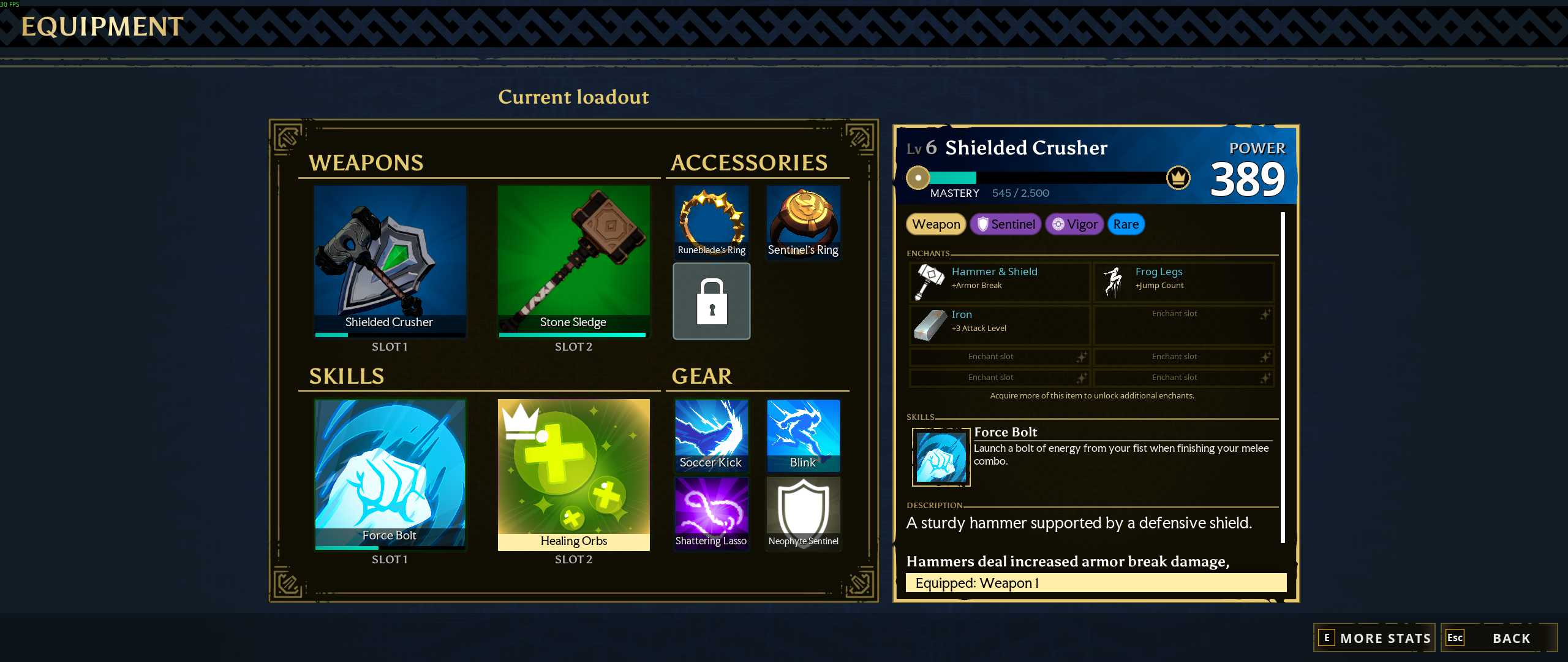
The game’s bread and butter is in its gameplay. It’s an action-oriented game, after all. There is a variety of characters to choose from, and the only thing your choice determines is how you look. Fear not, though, as the choice is not permanent and can be changed at any point should you wish. Following this, there are four main classes: Runeblade, Sentinel, Breaker, and Ranger. Much like your choice of character, your choice of classing is not exactly permanent either.
Cloudheim avoids locking you into a singular class and instead allows you to earn skills and progress any class at any time. This allows you to mix and match your combat skills in a variety of ways so you can fit any niche that you want. The game does this by assigning weapon types to specific classes, progression-wise. For instance, a simple sword will grant you progress for Runeblade skills, and using Hammers will grant you progress for Breaker. Earning progression is also reminiscent of Warframe’s progression model, where you use a weapon to master it. Where it differs is what you do once the weapon is considered “mastered”. In Warframe, you can continue working on the weapon to refine its capabilities more and more. In Cloudheim, you are better off moving onto the next weapon so you may unlock more and more skills, which can also be mastered, unlocking even more skills for their associated class (i.e., a Sentinel Skill’s mastery will progress the Sentinel class). It’s a method of progression that took me a moment to understand, but I think overall it allows for the game’s limited systems, especially during early access, to feel like they have a little more depth and there are avenues for experimentation. What truly benefits from this design choice is solo play, as it means that healing abilities are not locked to a single class but rather are waiting to be unlocked if you would like to use them.
What was also nice to see is how well-thought-out the cooperative side of the game is. A challenge many cooperative games come up against is how to distribute loot. Do you instance it per player? Do you allow players to effectively steal one another’s loot like the older Borderlands games? Overly restrictive loot systems can be a hindrance for players, as seen with Final Fantasy XIV, which provides the chance of getting absolutely no loot throughout a lot of its weekly content, especially raids. Cloudheim avoids this by sharing the loot amongst the group. What prevents this from being an easy system to game is that the loot pertains to the save file that is used to host the co-op session. This means that you can’t carry absurdly strong gear from one player’s save file to another. I was happy to see this extend all the way to crafted weapons. The resources are shared amongst the entire session, whenever gear is unlocked through crafting, it becomes unlocked for everyone playing.
Arguably one of the biggest draws of this game is base building/home decorating. The game introduces you to its store management and home decoration side fairly quickly. You get a pretty rough idea of what you can do, but it isn’t until you progress further through the game that the possibilities come to life. There’s a gorgeous tavern-style, two-storey building that slowly develops as your world’s shop level increases. How do you increase your shop level? By crafting goods using the resources and loot that you have obtained and subsequently selling them! It’s through these smaller, interwoven systems that Cloudheim ensures almost nothing goes to waste. You get resources to make nice things in order to sell them so then you can afford more and more of the nice decorations. You could also use some of those resources to upgrade your arsenal, I guess, but who would want that? By far the most important thing Cloudheim has to offer is the ability to buy cats for your base. Do they serve any purpose beyond looking cute? Absolutely not, and I would not have it any other way. There is one called Mr Evil and I love him. A cool tidbit is that these cats are modelled and named after the developers’ real-life cats.
Pretending that everything Cloudheim does is perfect would be disingenuous. For starters, when playing with my partner, it seemed there was a particular Breaker skill that did not like being used and would sometimes result in whoever used it being stuck. The only way to get out of this was to get yourself killed using the unstuck button and require revival from a teammate. When it came to the differences between running the game on my Linux install versus my Windows 10 install, I didn’t feel any discernible difference aside from the fact that, currently, the game lacks any support for Steam’s cloud saves (ironic considering the name of the game), which meant I had to dig through my Window 10 drive to find the save file in order to continue using it on Linux. A bit cumbersome, and can make it a hard pitch for people who use both a desktop and another device like the Steam Deck. However, support for this feature is in the roadmap laid out by developer Noodle Cat Games. The UI can also be a tad cumbersome, and there is no “mark all as read” button, so you will constantly have markers on new gear/upgraded gear, which can be annoying. The map also doesn’t seem to play nice with controllers, often resulting in zoom values that aren’t at all indicative of the minimum and maximum zoom available.
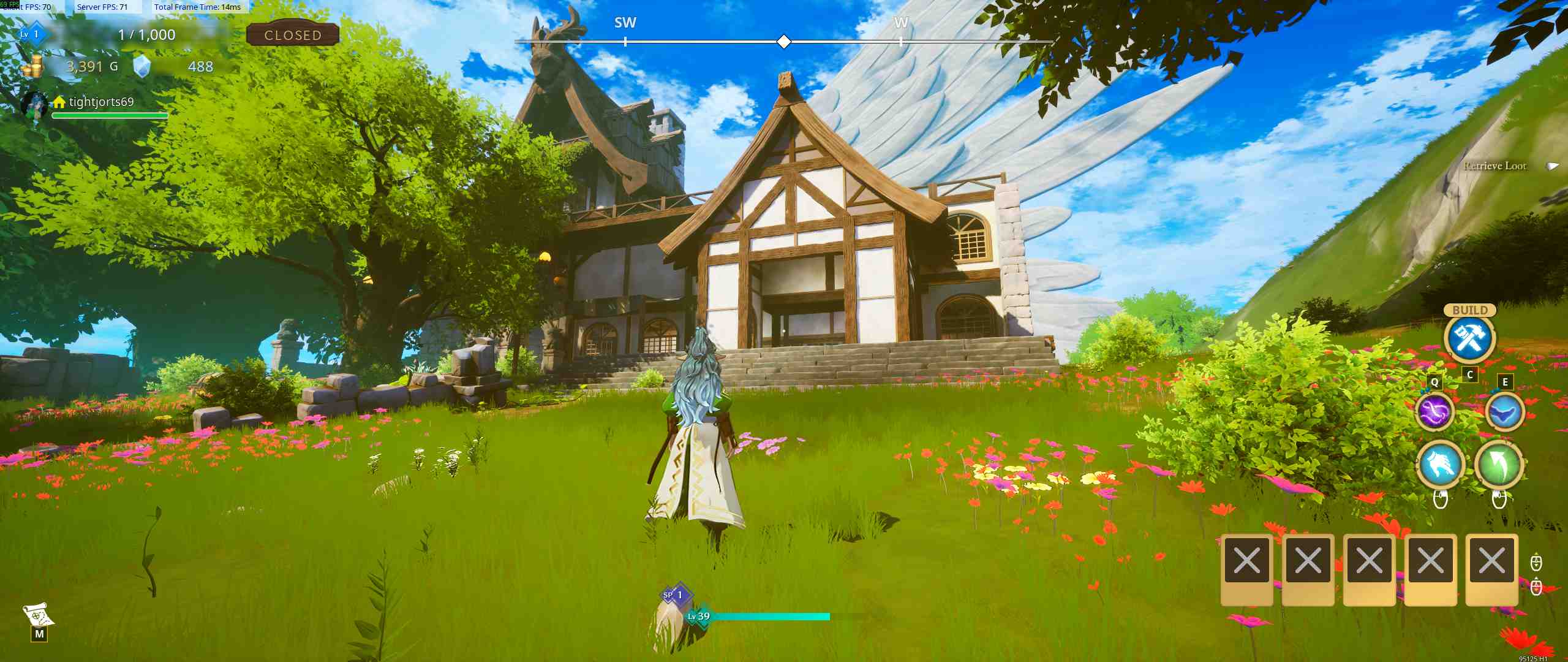
One thing that I immediately took note of when starting the game for the first time was how gorgeous both the art style and art direction are. These two elements are elegantly combined to create a truly stunning game without the need to be some technical behemoth that pushes the boundary of available technology. This doesn’t prevent it from running flawlessly, but performance is reasonable, with the occasional sore spot, which is forgivable considering the game is in early access. If Noodle Cat Games can manage to polish the optimisation with each update, I can see the game being incredibly smooth and fun.
What is worth mentioning is Noodle Cat Games’ use of AI. They have a public-facing statement that they created a bot called InfoSage whose purpose is to search through their own internal documentation and notify individuals regarding interesting points of discussion as well as assist in figuring out when bugs occurred during the update process. They also admit that individuals within the company are allowed to use generative AI but it is by no means a mandatory system for the studio and no jobs were replaced by AI.
Having gone through its first seasonal event, adding a new play area in Myrkstorm and just recently launching a major update in the form of Vault of the Gods, it is clear that Cloudheim has already made some great strides towards achieving its goals of a 1.0 launch. While not everything is ironed out yet, the game is well worth taking a look. However, if the studio’s potential use of Generative AI sours the whole package, I would not blame you.
PC early access codes supplied by publisher